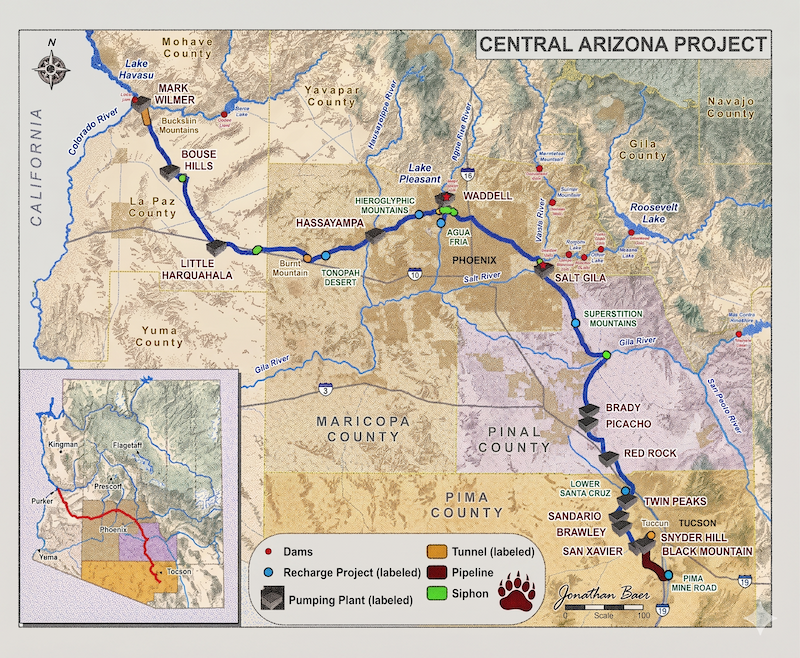
 Arizona Project aqueduct map showing the 336-mile water delivery route from Lake Havasu to Tucson across Maricopa, Pinal, and Pima counties
I recently attended a briefing by CAP (Central Arizona Project) and SRP (Salt River Project) — the two agencies managing the majority of metro Phoenix's water. The takeaways matter for anyone buying, selling, or investing in Arizona real estate. Here's what I learned.
Where Arizona's Water Comes From Today
Arizona draws from four primary sources. Right now, the mix looks like this:
Arizona's Current Water Supply Mix
The Central Arizona Project is the 336-mile aqueduct that carries Colorado River water from Lake Havasu to Tucson — a system that took 20 years and $4 billion to build (1973–1993). It serves 80 percent of Arizona's population across Maricopa, Pinal, and Pima counties, with 54% of its allocation going to municipal partners and 46% to tribal partners.
SRP, formed in 1903, manages a watershed covering one-third of Arizona — running six dams across the Salt and Verde rivers plus 270 ground wells averaging 1,000 feet deep, capable of pumping 2,000–2,500 gallons per minute. Combined, SRP holds 2.5 million acre-feet in recharge facilities.
Scottsdale is a useful benchmark: 72% of its water supply is CAP water. That's not a minor dependency — it's structural. Anthem operates under a 100-year water lease with the Ak-Chin Tribe for its CAP allocation.
The Colorado River Problem
The 1922 Colorado River Compact divided water rights between Upper and Lower Basin states based on estimates of 15 million acre-feet annually. The actual long-term average is 12.7 million acre-feet. Over the past five years it's dropped to 11.1 MAF — a compounding shortfall that was baked in from the start.
Arizona's normal CAP allocation is 1.6 million acre-feet per year. Under the current Tier 1 shortage declaration, that drops to approximately 1 million acre-feet. This year's projected Colorado River runoff: just 2.78 million acre-feet for the entire system. The Federal government determines delivery amounts for 2027.
Lake Powell is approaching dead pool — the level at which water can no longer flow through the dam. The 2026 Colorado River Operations Plan has expired, and Upper and Lower Basin states remain at an impasse. Upper Basin states are pushing to place 100% of required cuts on Lower Basin states — which includes Arizona.
SRP's Infrastructure Challenges
SRP's Verde River dams — Horseshoe and Bartlett — have lost 25–33% of their storage capacity to sediment buildup. The Verde River Sediment Mitigation Project is still in the feasibility stage, with four options on the table:
Build a New Bartlett Dam
Projected timeline: 2031–2032. Cost estimate: $3.7 billion. Partners include the Town of Cave Creek, Carefree Water Company, City of Phoenix, and City of Scottsdale.
Raise the Height of the Existing Dam
Increase storage capacity within the existing dam footprint at lower cost than new construction.
Dredge Bartlett and Horseshoe
Remove accumulated sediment to restore the dams' original storage capacity without new construction.
Do Nothing
Accept ongoing capacity loss and manage within progressively reduced storage constraints.
East Valley communities benefit from better aquifer access. The west side does not — a geographic divide that will intensify as surface water supplies tighten.
Long-Term Solutions — And Their Cost
Five strategic approaches are being pursued simultaneously. None of them are cheap:
Negotiations
Ongoing Upper and Lower Basin talks to establish a new post-2026 operating framework for the Colorado River. No agreement is currently in place.
Augmentation
Identifying entirely new water sources — desalination, atmospheric water, and ocean water transfers are all under state-level discussion.
Efficiency & Conservation
Reducing outdoor water use is the fastest lever available. Outdoor irrigation accounts for the majority of residential water consumption in desert climates.
Reuse / Recycled Water
Advanced Water Purification facilities are operational or coming online between 2027 and 2038. Direct potable reuse is a growing component of the long-term plan.
Aquifer Storage & Recovery
SRP's underground storage facilities — including Granite Reef and New River Aqua Fria — allow excess water from wet years to be banked and drawn down during dry ones. SRP currently holds 2.5 million acre-feet in storage.
The cost trajectory is the number that gets everyone's attention:
That's a roughly 10x increase in cost for augmented supply. That cost lands somewhere — on utilities, on developers, on property owners. The state will need a new revenue mechanism to fund the infrastructure required. It's not a question of if rates rise; it's a question of timeline and how the burden gets distributed.
What This Means If You're Buying, Selling, or Investing in the Phoenix Metro
Water is becoming a disclosed risk in Arizona real estate — not just a regulatory abstraction. Developments north of Phoenix in New River and Desert Hills rely primarily on groundwater. Communities like Anthem carry a 100-year water lease with the Ak-Chin Tribe through CAP. Scottsdale's 72% CAP dependency means any further shortage tier directly affects a market I work in daily.
The infrastructure investment ahead — whether a new Bartlett Dam at $3.7B, desalination facilities, or expanded water recycling — represents a generational commitment that will shape land values, development potential, and utility costs across the entire region.
Before buying in any submarket from Cave Creek to the TSMC corridor in North Phoenix, water security should be part of your due diligence conversation. I make it part of mine. That's not alarmism — it's what 30 years of closed transactions in this market has taught me to watch.
Have questions about a specific area?
I work across the Phoenix metro and North Scottsdale submarkets. Water supply, infrastructure timelines, and land use are part of every property conversation I have.