Welcome to the official blog of Dominion Group Properties—your trusted resource for real estate news, market analysis, and expert guidance across Phoenix, Scottsdale, North Phoenix, Cave Creek, Carefree, and Anthem. Whether you're a home buyer, seller, investor, or planning a relocation within the Valley, our blog delivers timely content to keep you informed.
What We Cover
Local Market Trends & Housing Reports: Stay updated with monthly insights on inventory, pricing, and market shifts in Phoenix and the North Valley.
Home Buying & Selling Strategies: From financing manufactured homes to pricing historic properties, our articles cover every step of the process.
Community & Development News: Learn about upcoming neighborhoods like Desert Hills, emerging job centers, and how primed areas are shaping investment opportunities.
Property Management & Landlord Tips: Make informed decisions whether you're leasing, investing, or managing a residential property in Arizona.
Why Our Blog Stands Out
Content anchored in real-world market data and local expertise across Phoenix Metro and surrounding regions.
Written and curated by Jonathan Baer—broker, licensed loan officer, and real estate advisor with over 30 years’ experience and $240 million in closed transactions in Maricopa County.
Blog topics tailored for actionable insights, whether flipping a home in Cave Creek, planning a move to Anthem, or financing a manufactured home in Phoenix.
Bookmark this page and check back regularly for fresh updates, expert commentary, and smart strategies for navigating Arizona’s dynamic real estate market.
About the Author: Jonathan Baer, Designated Broker and Real Estate Wealth Advisor at Dominion Group Properties, has completed over 1,000 transactions worth more than $240 million across Arizona.
If one of the goals on your list is selling your house and making a move this year, you’re likely juggling a mix of excitement about what’s ahead and feeling a little sentimental about your current home.
A great way to balance those emotions and make sure you’re confident in your decision is to keep these three best practices in mind when you’re ready to sell.
1. Price Your Home Right
The housing market shifted in 2023 as mortgage rates rose and home price appreciation started to normalize once again. As a seller, you still need to recognize how important it is to price your house appropriately based on where the market is today. Hannah Jones, Economic Research Analyst for Realtor.com, explains:
“Sellers need to become familiar with their local market and work closely with a local agent to make sure their listing is attractive to buyers. Buyers feeling the pressure of affordability are likely to be pickier, so a well-priced, well-maintained home is the ticket to drumming up big demand.”
If you price your house too high, you run the risk of deterring buyers. And if you go too low, you’re leaving money on the table. An experienced real estate agent can help determine what your ideal asking price should be, so your house moves quickly and for top dollar.
2. Keep Your Emotions in Check
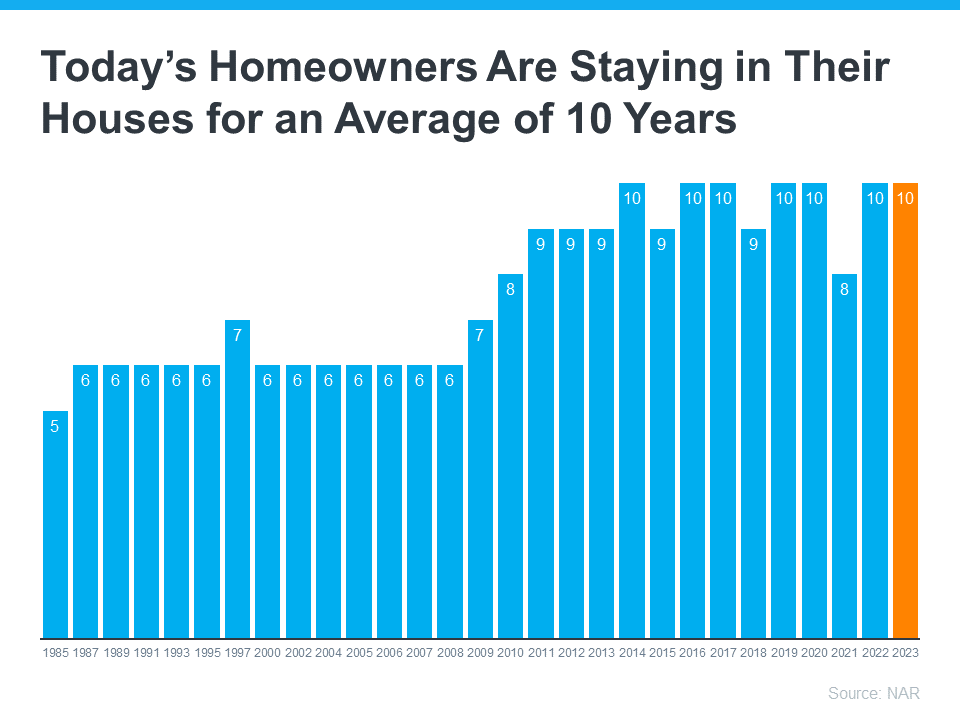
Today, homeowners are staying in their houses longer than they used to. According to the National Association of Realtors (NAR), since 1985, the average time a homeowner has owned their home has increased from 6 to 10 years (see graph below):
This is much more than what used to be the norm. The side effect, however, is when you stay in one place for so long, you may get even more emotionally attached to your space. If it’s the first home you bought or the house where your loved ones grew up, it very likely means something extra special to you. Every room has memories, and it’s hard to detach from the sentimental value.
For some homeowners, that makes it even tougher to separate the emotional value of the house from fair market price. That’s why you need a real estate professional to help you with the negotiations and the best pricing strategy along the way. Trust the professionals who have your best interests in mind.
3. Stage Your Home Properly
While you may love your decor and how you’ve customized your house over the years, not all buyers will feel the same way about your vibe. That’s why it’s so important to make sure you focus on your home’s first impression, so it appeals to as many buyers as possible.
Buyers want to be able to picture themselves in the home. They need to see themselves inside with their furniture and keepsakes – not your pictures and decorations. As Jessica Lautz, Deputy Chief Economist and Vice President of Research at NAR, says:
“Buyers want to easily envision themselves within a new home and home staging is a way to showcase the property in its best light.”
A real estate professional can help you with expertise on getting your house ready to sell.
Bottom Line
If you’re considering selling your house, let’s connect so you have help navigating the process while prioritizing these must-do’s.
2 Reasons Why Today’s Mortgage Rate Trend Is Good for Sellers
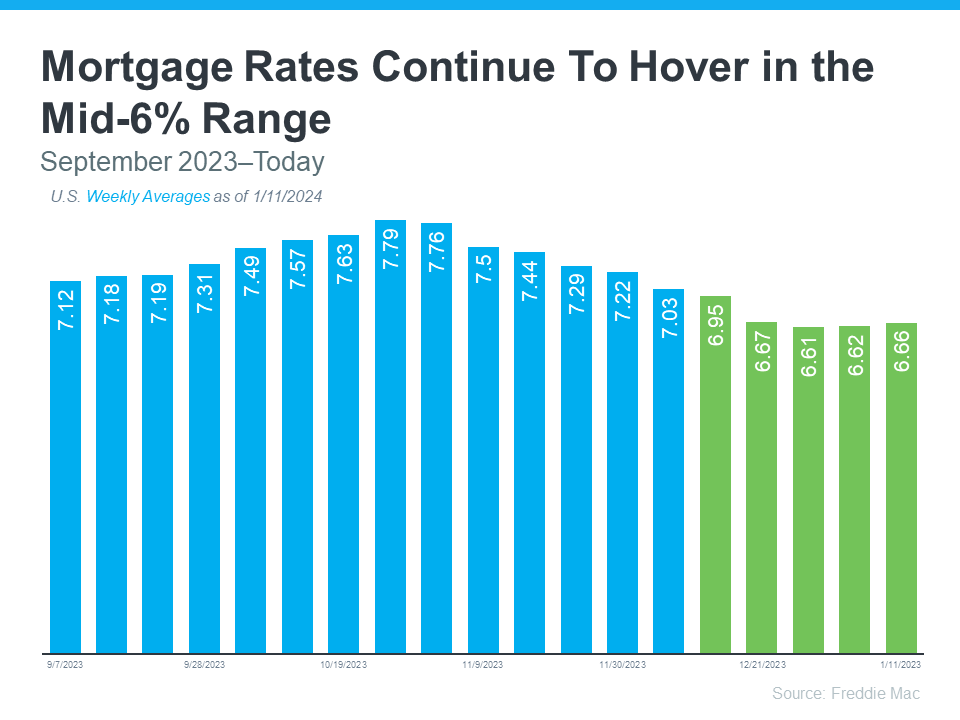
If you’ve been holding off on selling your house to make a move because you felt mortgage rates were too high, their recent downward trend is exciting news for you. Mortgage rates have descended since last October when they hit 7.79%. In fact, they’ve been below 7% for over a month now (see graph below):
And while they’re not going back to the 3% we saw during the ‘unicorn’ years, they are expected to continue to go down from where they are now in the near future. As Dean Baker, Senior Economist at the Center for Economic Research, explains:
“It also appears that mortgage rates are now falling again. They will almost certainly not fall to pandemic lows, although we may soon see rates under 6.0 percent, which would be low by pre-Great Recession standards.”
Here are two reasons why this recent trend, and the expectation it’ll continue, is such good news for you.
You May Not Feel as Locked-In to Your Current Mortgage Rate
With mortgage rates already significantly lower than they were just a few months ago, you may feel less locked-in to the current mortgage rate you have on your house. When mortgage rates were higher, moving to a new home meant possibly trading in a low rate for one up near 8%.
However, with rates dropping, the difference between your current mortgage rate and the new rate you’d be taking on isn’t as big as it was. That makes moving more affordable than it was just a few months ago. As Lance Lambert, Founder of ResiClub, explains:
“We might be at peak “lock-in effect.” Some move-up or lifestyle sellers might be coming to terms with the fact 3% and 4% mortgage rates aren’t returning anytime soon.”
More Buyers Will Be Coming to the Market
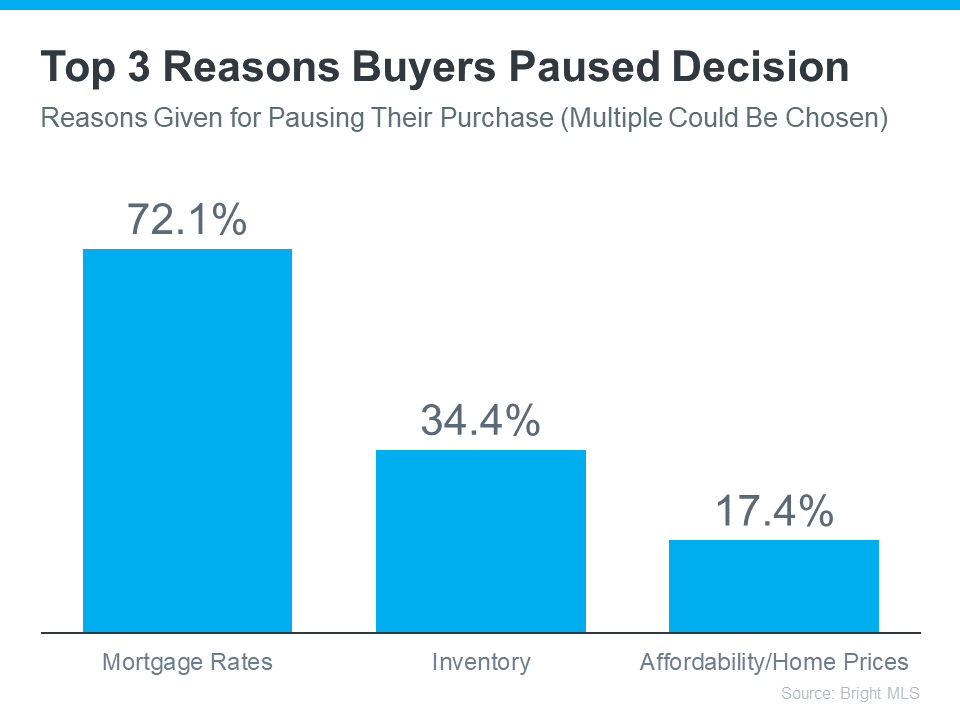
According to data from Bright MLS, the top reason buyers have been waiting to take the plunge into homeownership is high mortgage rates (see graph below):
Lower mortgage rates mean buyers can potentially save money on their home loans, making the prospect of purchasing a home more attractive and affordable. Now that rates are easing, more buyers are likely to feel they’re ready to jump back into the market and make their move. And more buyers mean more demand for your house.
Bottom Line
If you’ve been waiting to sell because you didn’t want to take on a larger mortgage rate or you thought buyers weren’t out there, the recent decline in mortgage rates may be your sign it’s time to move. When you’re ready, let’s connect.
Why You May Want To Seriously Consider a Newly Built Home
Are you putting off your plans to sell because you’re worried you won’t be able to find a home you like when you move? If so, it may be time to consider a newly built home and the benefits that come with one. Here’s why.
Near-Record Percentage of New Home Inventory
Newly built homes are becoming an increasingly significant part of today’s housing inventory. According to the most recent report from the National Association of Home Builders (NAHB):
“Newly built homes available for sale accounted for 31% of total homes available for sale in November, compared to an approximate 12% historical average.”
That means the percentage of the total homes available to buy that are newly built is well over two times higher than the norm. And even more new homes are on the way.
Recent data from the Census shows there’s been an uptick in both housing starts (where builders break ground on more new homes) and housing completions (homes where construction just wrapped).
And while some people may worry builders are building too many homes, that isn’t a concern – if anything, the recent increase is really good news. As Lawrence Yun, Chief Economist at the National Association of Realtors (NAR), explains:
“Even more home building will be needed with the housing shortage persisting in most markets . . . Another 30% rise in home construction can easily be absorbed in the marketplace . . .”
How This Helps You
Since the supply of existing homes for sale is still low right now, the increase of new-home construction can be a game changer because it gives you more options for your search.
Picture yourself in a home that’s new from the ground up: new appliances, fresh paint, fewer maintenance needs because everything is new, and so much more. Doesn’t that sound nice?
And it may be more within reach than you ever imagined. In addition, some builders are offering things like mortgage rate buy-downs for homebuyers right now. This can help offset today’s affordability challenges while also getting you into your dream home. In a recent article, Patrick Duffy, Senior Real Estate Economist at U.S. News, explains:
“Builders have been using mortgage interest rate buydowns for many years as a sales incentive whenever interest rates are relatively high, . . .Today more builders are offering rate buydowns for the entirety of the loan, allowing buyers to finance more home for the same payment amount.”
Just remember, the process of buying from a builder is different from buying from a home seller, so it’s important to partner with a trusted real estate agent who knows the local market. They’ll be your go-to resource for coordinating with the builder, reviewing contracts, and more.
Bottom Line
If you’re trying to sell so you can make a move but you’re having a hard time finding a home you like, let’s connect. That way you have a local expert to help you explore all of your options, including the newly built homes in our area.
Home Prices Forecast To Climb over the Next 5 Years [INFOGRAPHIC]
Some Highlights
If you’re worried about what’s next for home prices, know the HPES shows experts are projecting they’ll continue to rise at least through 2028.
Based on that forecast, if you bought a $400,000 house this year, experts say it could gain over $72,000 in equity over the next five years.
If you're worried about falling home prices, don't be. Many experts forecast they'll keep rising for years to come. If you have questions, let’s connect.
Let’s face it: the bathroom could probably use a paint job or the kitchen cabinets might need new handles. Those types of minor repairs can easily be done by yourself with a small budget and spare time, but when it comes to bigger repairs, it could be time to call in a professional contractor.
Hiring a pro not only makes repair jobs easier to complete, but it’s also safer for you. Also, having a professional contractor on the job will likely ensure a better result than you’d be able to do on your own. And sometimes, it’ll cost you less than a failed DIY.
Dominion Group Properties shares a few home repair projects that you shouldn’t attempt without the help of a pro.
Major Renovations
Feeling inspired by the renos you see on TV? While each episode might show a house almost entirely demolished and rebuilt in a single half hour episode, rest assured that they have entirely pro teams tackling each detail, and the compressed version of events only hits the highlights of months of work.
Problems
Issues like removing support walls, moving plumbing, moving wiring, shifting driveways, and changing airflow are just a few of the issues that complicate big renovations.
Fixes
If you’re thinking about a major renovation, even if you can take on many details yourself, Dumpsters.com gives some guidance regarding whether to hire an architect, a designer, or a draftsman - or when it’s likely safe to try the renovation yourself.
You may be able to DIY smaller areas of the renovation, like painting or hardware replacement. And if you have specific skills in welding or soldering, put those to use. Welding Logic is a free resource that offers great tips and tricks for upping your welding game.
When it comes to searching for a professional to do the work on, for example, fence installation or gutter cleaning, use an online services portal to research local service providers. Companies that are worth their salt will have positive ratings and reviews, but don’t be shy about asking for additional referrals.
Roofing
A roof that’s in need of repair often doesn’t present any problems until you notice a ceiling leak. Leaks are one of many roofing problems, and the others could go unnoticed until the damage is done because they may not show any obvious signs.
Problems
Roof damage can be caused by cracked flashing, damaged shingles, rotting from clogged gutters, deterioration from shrinkage, tree branch damage, holes from wildlife, cold weather damage from ice and wind, or simply poor installation.
Fixes
A roofer might be able to patch up your roof or replace some shingles for $300 to $1,200, but serious damage may require a roof replacement that costs thousands. It’s essential that you find a reputable contractor for the job. If a full roof replacement is required, and your budget doesn’t have room for that expense, consider refinancing your home.
Search online to learn how to refinance a mortgage and look for tips from companies that are well reviewed. Depending on how much you need to cash out and what the current rates are, refinancing might get you the cash you need and lower your monthly mortgage payments.
Plumbing
Plumbing issues in a household can arise at any time, causing inconveniences and headaches for the homeowners. Older homes are prone to more problems, but any plumbing system can be affected by roots and clogs.
Problems
Some of the most common plumbing problems include leaky pipes, clogged drains, low water pressure, and running toilets. Older homes may even have clay pipes that allow for roots to penetrate the porous surface and cause more damage.
Fixes
Each problem has its own unique solution, but it's best to call an experienced plumber to diagnose and fix the issue to prevent further damage. Regular maintenance can help prevent these problems from happening in the first place, saving homeowners from the hassle and expense of repairs.
Pest Control
Unless your house is new, you will likely encounter some type of pests. Cracks in the exterior allow these little bugs in, and once they find a comfortable home inside your walls, it’s difficult to remove them without professional extermination.
Problems
Out of all the common pests that take residence inside of homes, termites are perhaps the most damaging. Termites eat the wood in the walls and floors of your house, as well as your furniture. Over time, the structure begins to crumble as the termite population grows in size and continues to feast on the beams.
Fixes
Termites can become winged and unwinged, so know what to look for in your home. If you spot a termite (or a swarm in warmer months) or feel hollowed-out wood on the wall and floor surfaces, then it’s time to call pest control to handle the matter. The price will vary depending on whether you need spot treatment or fumigation with tenting. Terminix points out that the average cost to control or inspect for termites is usually between $400–$1,500.
HVAC
HVAC systems maintain the quality of your indoor air. Because indoor air quality can have a direct effect on your health, it’s important to have a functional system even if your house never gets cold enough to require a heater or hot enough to require an air conditioner.
Problems
HVAC systems occasionally malfunction or fail over time. The damage could be in the compressor, condensor coil, drain line, refrigerant, furnace ignitor, blower motor, heat exchanger, gas valve, and more. An HVAC repair could also include replacing air filters to ensure cleaner indoor air through the filtration of toxins.
Fixes
Replacing, repairing, or flushing a part of your heating and cooling system could cost from $100 to several thousand dollars, depending on what needs to be done.
Homeowners Insurance and Warranties
Homeowners are often confused about the difference between their insurance coverage and home warranty. So, you’re not alone if you’re asking “what is a home warranty?” These different protections give peace of mind by covering the cost of many common home repairs. Homeowners insurance protects your structure, and normally comes through for you when you experience a weather event or similar hiccup. But what exactly does a home warranty cover? It's important to explore what a home warranty covers before deciding to invest in one.
Typically, home warranties cover major home systems such as plumbing, electrical, and HVAC. Additionally, some warranties may cover appliances such as dishwashers and refrigerators. By knowing what is covered under a home warranty, homeowners can make an informed decision and ensure they have the coverage they need to protect their home and wallet.
Be Wise with Your Home-Related Investments
Home ownership is a give-and-take process with finances. The take is that you’ll save money by paying a mortgage instead of rent, and every dollar you spend will go back into the investment you’ve made. The give is that you’ll need to put money into improving and maintaining your home. While hiring a professional costs more than a DIY project, you get what you pay for in the end: a job well done.
Ways Your Home Equity Can Help You Reach Your Goals
If you’ve owned your house for at least a couple of years, there’s something you’re going to want to know more about – and that’s home equity. If you’re not familiar with that term, Freddie Macdefines it like this:
“. . . your home’s equity is the difference between how much your home is worth and how much you owe on your mortgage.”
That means your equity grows as you pay down your home loan over time and as home values climb. While it’s true home prices dipped slightly last year, they rebounded and have been climbing in many areas since then. Here’s why that price growth is good news for you.
In the latest Equity Insights Report, Selma Hepp, Chief Economist at CoreLogic, explains:
“With price gains continuing to help homeowners build wealth, equity has reached a new high and regained losses that resulted from declines last year. And while the average U.S. homeowner gained over $20,000 in additional equity compared with the third quarter of 2022, some markets are seeing larger increases as price growth catches up.”
And that figure is just for the last year. To help you really understand how that number can add up over time, the report also says the average homeowner with a mortgage has more than $300,000 in equity. That much equity can have a big impact.
Here are a few examples of how you can put your home equity to work for you.
1. Buy a Home That Fits Your Needs
If your current space no longer meets your needs, it might be time to think about moving to a bigger home. And if you’ve got too much space, downsizing to a smaller one could be just right. Either way, you can put your equity toward a down payment on something that fits your changing lifestyle.
2. Reinvest in Your Current Home
And, if you’re not ready to move just yet, you can use the equity you have to improve your current home. But it’s important to consider the long-term benefits certain upgrades can bring to your home’s value. A real estate agent is a great resource on which projects to prioritize to get the greatest return on your investment when you sell later on.
3. Pursue Personal Ambitions
Home equity can also serve as a catalyst for realizing your life-long dreams. That could mean investing in a new business venture, retirement, or funding an education. While you shouldn’t use your equity for unnecessary spending, using it responsibly for something meaningful and impactful can really make a difference in your life.
4. Understand Your Options to Avoid Foreclosure
While the number of foreclosure filings remains below the norm, there are still some homeowners who go into foreclosure each year. If you’re in a tough spot financially, having a clear understanding of your options can help. Equity can act as a cushion if you’re not able to make your mortgage payments on time.
Bottom Line
If you want to know how much equity you have in your home, let’s connect. That way you have someone who can do a professional equity assessment report on how much you’ve built up over time. Then let’s talk through how you can use it to help you reach your goals.
Procter & Gamble’s New Manufacturing Facility in Coolidge, Arizona: A Boon for the Local Economy
Procter & Gamble (P&G), the global consumer goods giant, has announced plans to build a state-of-the-art manufacturing facility in Coolidge, Arizona. This significant development, representing a $500 million investment, is poised to create approximately 500 new jobs and further bolster Arizona's booming manufacturing sector.
Key Highlights of the Project
Strategic Location and Scale: The new facility will be situated on 427 acres at Inland Port Arizona in Coolidge, approximately 60 miles southeast of Phoenix. This location was chosen for its strategic advantages, including access to key infrastructure and a skilled workforce. The facility is set to support P&G’s fabric care portfolio, which includes popular products like Tide PODS®, Downy Unstopables®, and Bounce® Dryer Sheets. Construction is expected to begin in 2023, with the plant becoming operational by 2025 (AZ Biz Know How) (ExpSolutionMag).
Economic Impact: The establishment of this manufacturing plant is a testament to Arizona's growing appeal as a manufacturing hub. Governor Doug Ducey emphasized that P&G's decision to build in Coolidge underscores the state’s competitive edge in attracting global leaders in various industries. He noted that this investment would add hundreds of good-paying jobs in Pinal County, further strengthening the local economy (AZ Biz Know How) (AZ Big Media).
Community and Business Support: Local officials and business leaders have expressed strong support for P&G's investment. Martin Hettich, P&G Senior Vice President for Fabric Care in North America, highlighted the importance of the Coolidge facility in supporting the company’s business and fostering long-term partnerships with the community. Sandra Watson, President and CEO of the Arizona Commerce Authority, praised Pinal County's attractiveness as a premier manufacturing destination, citing its skilled workforce and robust infrastructure (AZ Biz Know How) (ExpSolutionMag).
The Broader Context of Arizona's Manufacturing Growth
P&G's decision to establish operations in Coolidge is part of a larger trend of economic growth and industrial expansion in Arizona. The state has seen a surge in activity across various sectors, including semiconductors, electric vehicles, and batteries. Notable companies like Nikola, Lucid Motors, and Kohler have already set up operations in the region, contributing to a dynamic and diversified manufacturing ecosystem (AZ Biz Know How) (AZ Big Media).
Inland Port Arizona: Inland Port Arizona, the industrial park hosting the new P&G facility, is rapidly becoming a focal point for industrial development in the state. The park’s location offers logistical advantages that are attractive to major corporations. This has made it an ideal site for companies looking to expand their manufacturing capabilities while benefiting from Arizona's pro-business environment (AZ Big Media) (ExpSolutionMag).
Environmental and Sustainability Considerations: While details on the specific environmental strategies for the new P&G facility are not extensively covered in the announcements, it is expected that modern manufacturing practices and sustainability measures will be integral to its operations. P&G has a strong track record of incorporating sustainability into its manufacturing processes, which likely will continue with the Coolidge facility.
Looking Ahead
The new P&G plant is more than just a manufacturing facility; it represents a significant milestone in Arizona’s economic development journey. As the state continues to attract high-profile investments, the local communities stand to benefit from increased employment opportunities, enhanced infrastructure, and a more robust economic landscape.
Local leaders are optimistic about the long-term benefits of P&G’s presence in Coolidge. Stephen Q. Miller, Supervisor for District 3 in Pinal County, expressed appreciation for the company's trust in the region's business environment and the anticipated support for P&G's long-term success. Mayor Jon Thompson of Coolidge echoed these sentiments, highlighting the positive impact on the local economy and workforce opportunities (AZ Biz Know How) (AZ Big Media) (ExpSolutionMag).
In conclusion, the construction of Procter & Gamble’s new manufacturing facility in Coolidge, Arizona, marks a significant investment in the state’s future. It not only reinforces Arizona's status as a premier destination for industrial development but also promises substantial economic benefits for the local community. As the project progresses, it will be interesting to see how it shapes the region's economic landscape and contributes to P&G's growth strategies.
Avoid These Common Mistakes After Applying for a Mortgage
If you’re getting ready to buy a home, it’s exciting to jump a few steps ahead and think about moving in and making it your own. But before you get too far down the emotional path, there are some key things to keep in mind after you apply for your mortgage and before you close. Here’s a list of things to remember when you apply for your home loan.
Don’t Deposit Large Sums of Cash
Lenders need to source your money, and cash isn’t easily traceable. Before you deposit any cash into your accounts, discuss the proper way to document your transactions with your loan officer.
Don’t Make Any Large Purchases
It’s not just home-related purchases that could disqualify you from your loan. Any large purchases can be red flags for lenders. People with new debt have higher debt-to-income ratios (how much debt you have compared to your monthly income). Since higher ratios make for riskier loans, borrowers may no longer qualify for their mortgage. Resist the temptation to make any large purchases, even for furniture or appliances.
Don’t Cosign Loans for Anyone
When you cosign for a loan, you’re making yourself accountable for that loan’s success and repayment. With that obligation comes higher debt-to-income ratios as well. Even if you promise you won’t be the one making the payments, your lender will have to count them against you.
Don’tSwitch Bank Accounts
Lenders need to source and track your assets. That task is much easier when there’s consistency among your accounts. Before you transfer any money, speak with your loan officer.
Don’t Apply for New Credit
It doesn’t matter whether it’s a new credit card or a new car. When your credit report is run by organizations in multiple financial channels (mortgage, credit card, auto, etc.), it will have an impact on your FICO® score. Lower credit scores can determine your interest rate and possibly even your eligibility for approval.
Don’t Close Any Accounts
Many buyers believe having less available credit makes them less risky and more likely to be approved. This isn’t true. A major component of your score is your length and depth of credit history (as opposed to just your payment history) and your total usage of credit as a percentage of available credit. Closing accounts has a negative impact on both of those parts of your score.
Do Discuss Changes with Your Lender
Be upfront about any changes that occur or you’re expecting to occur when talking with your lender. Blips in income, assets, or credit should be reviewed and executed in a way that ensures your home loan can still be approved. If your job or employment status has changed recently, share that with your lender as well. Ultimately, it’s best to fully disclose and discuss your intentions with your loan officer before you do anything financial in nature.
Bottom Line
You want your home purchase to go as smoothly as possible. Remember, before you make any large purchases, move your money around, or make major life changes, be sure to consult your lender – someone who’s qualified to explain how your financial decisions may impact your home loan.
The large population of seniors with Alzheimer’s and dementia in long-term care communities may in part be due to the challenge of managing the condition. When a senior starts experiencing symptoms of Alzheimer’s or dementia, many families realize that it’s in their loved one’s best interest toseek out memory care. Due to the symptoms that accompany memory loss, continuing tolive at home without professional help can become unhealthy andunsafe for some seniors.
Memory care communities provide a safe alternative for seniors living with memory impairment. These facilities are staffed by professionals who are specifically trained to provide care to Alzheimer’s and dementia patients, and are designed to accommodate older adults with progressive cognitive disorders. This guide will provide more detail about memory care to help caregivers and family members better understand what memory care is and how to choose the community.
What Is Memory Care?
A memory care community is a residential care facility or unit of a residential care facility that is designed specifically to meet the needs of people who have Alzheimer’s disease or other dementias. Memory care communities strive to provide residents with a high quality of life while taking additional measures to ensure their safety. There may be security measures in place to ensure that residents do not wander, for example, and some units are locked so that no one may leave or enter.
Memory care facilities may also give you the option of specialized care to help your aging loved one manage their medications and healthcare. These facilities care not just for individuals’ medical needs, however. They also frequently offer opportunities to socialize or engage in hobbies in ways that work best for people with impaired memories. Some communities may offer pleasurable activities, such asvisits from therapy pets, musical entertainment, or the opportunity to spend time in the gardens, that are known to be particularly beneficial for people living with cognitive changes.
What Are the Benefits of Memory Care?
Memory care offers seniors with dementia and Alzheimer’s numerous benefits, includingcognitive stimulation, emergency monitoring, and support from specially-trained staff. This can lead to other benefits like a higher quality of life, less use of antipsychotic medications, and improved medical care for other health issues. Some of the most prominent benefits of memory care are explained in more detail below.
Care Coordination: Your loved one’s team will work together, including your aging parent as appropriate, to ensure comprehensive care.
Staff Knowledge and Competency: The staff can demonstrate training and the necessary skill set to prepare them to work with people who have cognitive impairments.
Activity Programming Based on Abilities: Activities are available that suit your aging loved one’s cognitive ability, memory, attention span, language, reasoning ability, and physical function.
Behavior Management: The behaviors associated with Alzheimer’s disease and other dementias are addressed first through non-pharmacological means, such as taking a look at scheduling, environment, and other possible triggers for the behavior.
Safe and Supportive Physical Environment: The physical environment is managed by the staff to reduce stress and overstimulation, and to keep all residents safe.
How Does Memory Care Compare to Other Senior Care Options?
Memory Care vs. Assisted Living
Assisted living is a long-term living option designed for seniors who need some help with activities of daily living (ADLs). Residents of assisted living communities live as independently as they’re able, but with the knowledge that helping hands are never too far away.
Assisted living communities have trained employees on-site around-the-clock to help residents with their ADLs. However, these employees are typically not trained to care for seniors with memory loss, and ALFs do not offer the specialized medical care and safety measures in place at memory care facilities. Additionally, because people with dementia and other memory problems typically require more extensive, specialized care than other older adults, memory care facilities tend to be pricier than assisted living facilities.
Memory Care vs. Nursing Home Care
Nursing homes offer a more intensive level of medical care than any other type of senior living. People living in nursing homes are typically less able to live independently or care for themselves than people who can live in an assisted living facility, and the available services reflect this. But the high-level of care offered at nursing homes is typically more focused on medical care rather than memory care. Those living with memory impairment may not be able to receive the personalized attention and cognitive stimulation that they need in a nursing home setting.
As with assisted living facilities, some but not all nursing homes may have a special memory care unit or have trained memory care staff. No matter which type of senior care facility you’re looking into, it’s important to ask about staff members’ level of memory care knowledge and training if you have an aging parent with dementia or Alzheimer’s disease.